








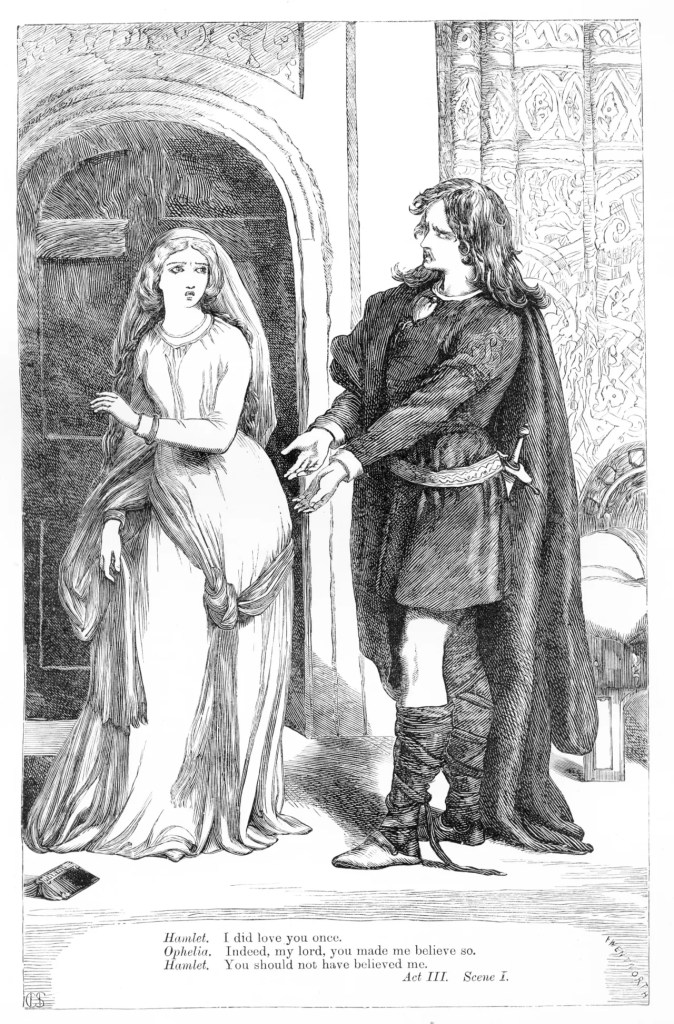
Ophelia — 14 Ferbruar
Hogy ismerem én meg
Hív szerelmed’ mástól?
Pörge kalap-, botja-,
S fűzött sarujáról.
Meghalt, kimult ő, asszonyom;
Meghalt, kimult, bizony!
Fejétül neki zöld-hant gyepágy,
Lábtul egy kő vagyon.
Oly hófehér a szemfedél –
Virággal van tele;
Sirjába őt a szeretet
Síratva nem tette le.
How should I your true-love know
From another one?
By his cockle bat and’ staff
And his sandal shoon.
He is dead and gone, lady,
He is dead and gone;
At his head a grass-green turf,
At his heels a stone.
White his shroud as the mountain snow-
Larded all with sweet flowers;
Which bewept to the grave did not go
With true-love showers.
Wie erkenn ich dein Treulieb
Vor den andern nun?
An dem Muschelhut und Stab
Und den Sandelschuhn.
Er ist lange tot und hin,
Tot und hin, Fräulein!
Ihm zu Häupten ein Rasen grün,
Ihm zu Fuß ein Stein.
Sein Leichenhemd weiß wie Schnee zu sehn –
Geziert mit Blumensegen,
Das unbetränt zum Grab mußt gehn
Von Liebesregen.
Kérem, egy szót se erről; de ha kérdik mit jelent, csak mondja ezt:
Pray let’s have no words of this; but when they ask, you what
it means, say you this:
Bitte, laßt uns darüber nicht sprechen; aber wenn sie Euch fragen, was es bedeutet, sagt nur:
Holnap szent Bálint napja lesz,
Mindjárt reggel korán;
És ablakodnál, párodul,
Ott leszek, én leány.
Kelt a legény, felöltözött,
Ajtót nyitott neki;
Bement a lány, de mint leány
Többé nem jöve ki.
To-morrow is Saint Valentine’s day,
All in the morning bedtime,
And I a maid at your window,
To be your Valentine.
Then up he rose and donn’d his clo’es
And dupp’d the chamber door,
Let in the maid, that out a maid
Never departed more.
Auf morgen ist Sankt Valentins Tag,
Wohl an der Zeit noch früh,
Und ich ‘ne Maid am Fensterschlag
Will sein eur Valentin.
Er war bereit, tät an sein Kleid,
Tät auf die Kammertür,
Ließ ein die Maid, die als ‘ne Maid
Ging nimmermehr herfür.
Biz úgy, hen! No de végzem már, esküdözés nélkül:
Indeed, la, without an oath, I’ll make an end on’t!
Fürwahr, ohne Schwur, ich will ein Ende machen:
Irgalmas ugyse! a legény,
Ohjaj! szégyen! piha!
Ha hozzá fér, hát megteszi;
Bizisten rút hiba.
Míg meg nem csaltál, elveszesz,
Nem azt igérted-e?
Úgy is lett volna, esküszöm:
Ne jöttél volna be!
By Gis and by Saint Charity,
Alack, and fie for shame!
Young men will do’t if they come to’t
By Cock, they are to blame.
Quoth she, ‘Before you tumbled me,
You promis’d me to wed.’
He answers:
‘So would I ‘a’ done, by yonder sun,
An thou hadst not come to my bed.’
Bei unsrer Frau und Sankt Kathrin!
O pfui! was soll das sein?
Ein junger Mann tuts, wenn er kann,
Beim Himmel, ‘s ist nicht fein.
Sie sprach: Eh Ihr gescherzt mit mir,
Gelobtet Ihr mich zu frein.
Er antwortet:
Ich brächs auch nicht, beim Sonnenlicht!
Wärst du nicht kommen herein.
Fordította: Arany János (1817-1882)
William Shakespeare: Tragedy of Hamlet, Prince of Denmark
Act IV, Scene 5
Übersetzer / Translator: August Wilhelm von Schlegel (1767-1845)
Lásd még / See also (HU):
Szent Bálint vértanú, aki a szerelmesek pártfogója lett. Magyar Kurír, 2024. február 14.

 Katakombablog
Hozzászólás